
Agricultural machinery operates in an environment where fluid lines rarely receive the protection available inside a factory or vehicle cabin. Sunlight, dust, crop residue, fertilizers, pesticides, vibration, mud, and repeated bending can all act on the same tube during one working season.
That combination makes nylon pipe selection a question of exposure rather than pressure rating alone. DEKUMA is a manufacturer of rubber and plastic processing machinery and extrusion systems, with multilayer tube equipment that supports the production of tubing for demanding fluid-handling applications.
Field Exposure Changes Material Requirements
UV radiation becomes an important consideration whenever tubing remains exposed on sprayers, planters, harvesters, or irrigation-related machinery. Continuous sunlight can gradually affect polymers, particularly when the outer surface is also exposed to heat and airborne contaminants. Parker’s agricultural product information, for example, identifies nylon tubing with heat and light stabilization for demanding applications, while other nylon series are specified with UV resistance and chemical resistance.
Chemical exposure creates another layer of complexity. Agricultural equipment may carry or distribute fertilizers, herbicides, pesticides, lubricants, cleaning agents, or treated water, and compatibility depends on the exact chemical, concentration, temperature, and exposure duration. A material that performs well with water may behave differently around concentrated agricultural chemicals. Tube selection should consequently rely on chemical-compatibility data rather than treating all field fluids as equivalent.
Mechanical contact is just as important. Crop residue can rub against exposed lines as machinery passes through dense vegetation, while clamps, brackets, and nearby metal components can create localized wear points. Parker lists abrasion resistance and chemical resistance among relevant characteristics for agricultural nylon-core hose applications. The practical objective is not simply a tougher polymer, but a tube construction suited to the locations where abrasion actually occurs.
Balancing Grade, Wall Structure, and Cost
Not every agricultural application requires the same level of protection. A protected control line inside an enclosed machine may experience limited UV exposure and little physical contact, while a sprayer boom line can face sunlight, chemical contact, vibration, and repeated flexing simultaneously. Using one highly specified material across every circuit can increase material cost without addressing the actual failure mechanism.
Wall thickness also influences the balance. Increasing thickness can improve mechanical robustness, but it may add weight, reduce flexibility, increase material consumption, and affect installation around tight machine assemblies. In other cases, a multilayer structure can assign different functions to separate layers.
One layer may provide chemical compatibility while another contributes mechanical protection or dimensional stability. The resulting composite tube can be designed around the specific combination of exposure rather than relying on wall thickness as the only defense.
Designing Around Abrasion and Movement
Routing often determines whether an otherwise suitable tube survives field service. Lines should avoid unnecessary contact with sharp edges, moving linkages, rotating components, and areas where crop material can become trapped. Clamp spacing matters as well: excessive unsupported length allows movement and vibration, while overly rigid restraint can concentrate stress around the attachment point. The appropriate arrangement depends on the machine’s motion profile rather than a universal spacing rule.
Bending creates another concern around articulated booms and moving implements. A line that repeatedly bends at the same point can experience fatigue even if its pressure remains well below the rated value. The minimum bend radius, dynamic movement, fitting geometry, and cycle frequency should be considered together. In applications where the tube is repeatedly repositioned, a flexible material formulation may be more valuable than simply increasing wall thickness.
Chemical and abrasion protection can also be separated through construction. A composite tube may use different materials in the inner and outer regions, allowing the fluid-contact surface and environmental surface to address different requirements. Such an approach can be useful where the transported medium demands chemical resistance but the outside of the tube faces physical wear. The design still requires validation against the actual chemical and mechanical environment; multilayer construction by itself does not make a tube universally resistant.
Production Consistency and Application-Specific Construction
Consistent tube geometry becomes particularly important when fittings, clamps, and protective sleeves are designed around fixed dimensions. Variations in outside diameter or wall thickness can affect insertion depth, retention, sealing, and routing. Agricultural equipment manufacturers may also purchase tubing in substantial quantities, making repeatability across production batches relevant to assembly consistency and replacement parts.
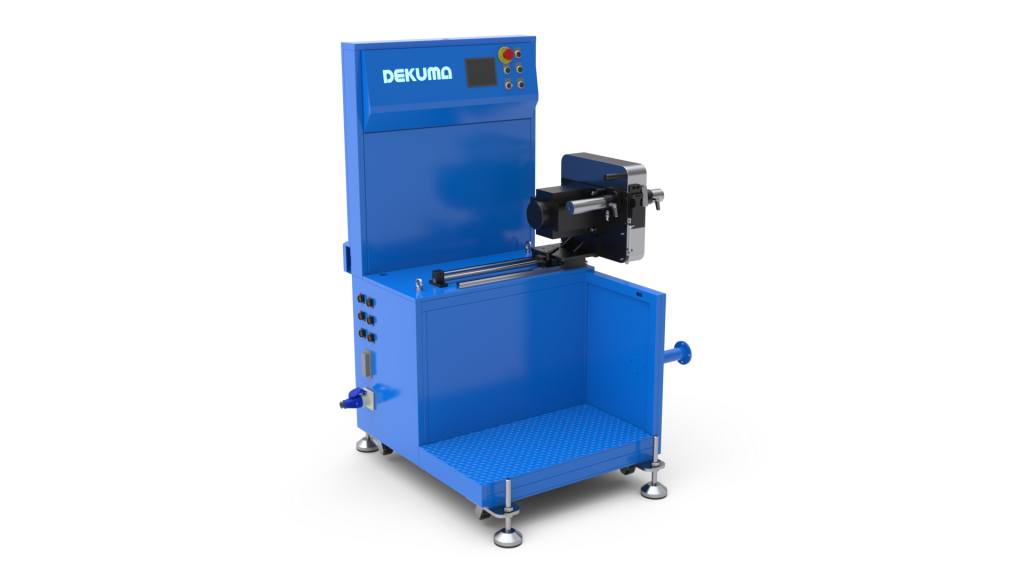
DEKUMA’s Multi-layer Nylon Composite Tube Extrusion Line includes an electronically controlled cutting unit with continuous and intermittent cutting modes, a servo-driven cutting mechanism, and a stated cutting accuracy of ±1 mm/m. Bottom support rollers are designed to facilitate changeover with downstream corrugation equipment. Such downstream control is one part of a broader production chain in which extrusion, calibration, traction, cutting, and handling collectively influence finished-tube consistency.
Conclusion
Agricultural tubing faces a combination of exposures that can change from one section of the same machine to another. Sunlight affects exposed surfaces, chemicals challenge material compatibility, crop residue introduces abrasion, and articulated equipment creates repeated bending. Nylon pipe selection consequently involves more than comparing pressure ratings or choosing the lowest material cost. Grade, stabilization, wall structure, flexibility, routing, and expected service environment all have a place in the specification.DEKUMA‘s extrusion technology demonstrates how multilayer production and controlled downstream processing can support application-specific tube construction. The broader engineering lesson is that durability should be allocated according to actual field exposure: protected sections may need little additional protection, while highly exposed areas may justify specialized material combinations or multilayer structures. A composite tube can provide one route toward that balance, particularly when different parts of the tube wall need to address different operating demands.